
About This Course
You're a licensed counselor, social worker, marriage and family therapist, psychologist, or addiction counselor, and many of your clients bring their Catholic faith into the room. Sometimes that faith is a real source of safety. Sometimes it's where old attachment wounds quietly repeat. Prayer can steady a client, or it can leave them feeling worse. This course is for those moments: when a client describes God's love in beautiful terms while their body tells a different story, or when Mary feels warm and God the Father feels distant. It builds on what you already know about attachment and trauma-informed pacing. You'll learn to apply Brown and Elliott's five conditions for secure attachment to a client's relationships with God, Mary, and the saints. You'll use structured clinical conversations to explore who a client turns to when frightened, and compare three attachment-based approaches to spiritual resourcing. You'll also learn when not to use these methods: the stabilization that comes first, and the situations where a protocol can do harm. Throughout, you'll see clearly what the research supports and where it's still developing. You'll also see what the tools are and aren't: structured ways to open a conversation, not validated measures. You don't need to share your client's faith to take this course. It's open to clinicians of any faith background who serve Catholic clients. If Catholic belief and practice are new to you, we recommend completing Level One, Series 3 first. Course Details Instructor: Peter Martin, PsyD, LP Level: Intermediate Continuing education: 1.25 NBCC contact hours Format: Self-paced and on demand. Two video chapters, a required Clinical Application Guide, client tools, a posttest, and a course evaluation. Scope: This course introduces the Ideal Parent Figure protocol, EMDR resource installation, and the Developmental Needs Meeting Strategy. It does not certify competence in them; each requires separate training.
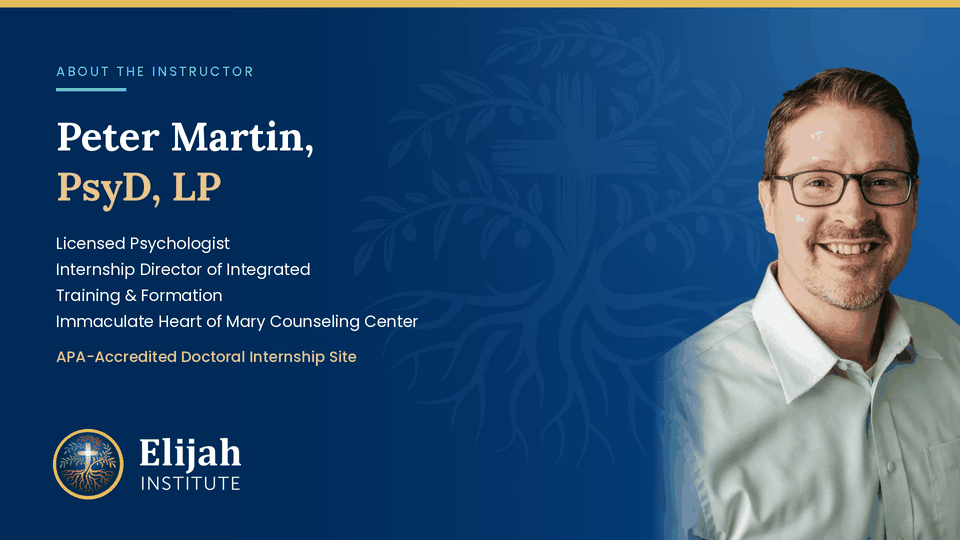
About Dr. Peter Martin
Dr. Peter Martin is a licensed psychologist in Nebraska and Internship Director of Integrated Training and Formation at the Immaculate Heart of Mary Counseling Center in Lincoln, a site of the APA-accredited Nebraska Internship Consortium in Professional Psychology. There, he helps form the next generation of psychologists to integrate Catholic faith with sound clinical practice. Dr. Martin earned his Doctor of Psychology from the Institute for the Psychological Sciences (now Divine Mercy University) in 2009. He also holds master's degrees in clinical psychology, religious studies, and counseling psychology. He has been in clinical practice since 2007, and in 2008 he opened a counseling outreach at the University of Nebraska Newman Center. His clinical work focuses on: college students, adults, couples, and families trauma, anxiety, depression, perfectionism, and personality concerns EMDR, Internal Family Systems, and forgiveness therapy Across all of it, his specialty is integrating a Christian understanding of the person with evidence-based care. He developed the Level of Attachment Security in Spiritual Relationships (LASSR) worksheet taught in this course. He has also served on the Executive Board of the Catholic Psychology Association and the board of Witness to Love. For the Elijah Institute, Dr. Martin also teaches Forgiveness as a Therapeutic and Sacramental Tool, Parts One and Two.
What You'll Learn
-
-
(Included in full purchase)
Assessing Level of Attachment Security in Catholic Spiritual Relationships
-
(Included in full purchase)
-
-
(Included in full purchase)
Models of Catholic-Focused Spiritual Resourcing
-
(Included in full purchase)
-
-
(Included in full purchase)
Clinical Application Guide Attachment Security and Spiritual Resourcing
-
(Included in full purchase)
-
-
(Included in full purchase)
LASSR Client Tool
-
(Included in full purchase)
SSW-2 Client Tool
-
(Included in full purchase)
Divine Mercy Meditation Client Tool
-
(Included in full purchase)
Ready to Transform Your Spiritual Clinical Work?
This course is built for clinicians who refuse to choose between precision and compassion. You'll leave with a framework that honors both your clients' faith and their nervous systems—and the tools to know the difference.
$75.00